
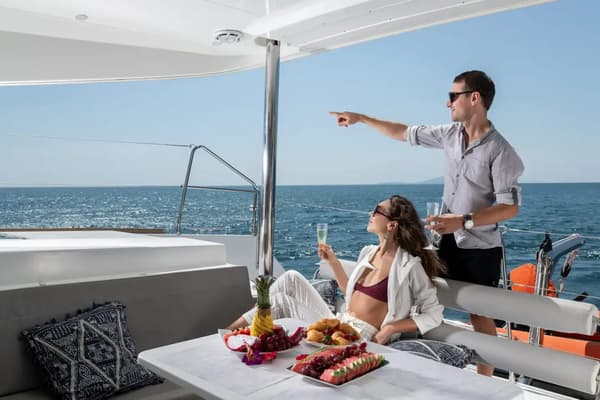
Browse Skippered Catamaran Rental Deals
Browse Crewed Catamaran Rental Deals
A skippered catamaran charter includes a professional captain who sails the yacht and ensures safety, while guests manage cooking, provisioning, and daily onboard tasks. A fully crewed catamaran charter includes a captain plus additional crew (typically a chef or hostess) who handle sailing, meals, cleaning, and all guest service.
The difference lies in responsibility, comfort level, cost structure, and how actively you want to participate in your sailing holiday. This guide covers both formats in practical terms, including who each option suits, how costs compare, and what the experience actually feels like across different destinations and group types.
A skippered catamaran charter is a holiday format where you rent a yacht and hire a licensed captain to operate it. The skipper is responsible for navigation, route planning, docking, anchoring, and overall maritime safety. In a charter context, their role is nautical rather than hospitality-focused.
Guests remain responsible for daily living arrangements on board. This includes grocery provisioning, cooking, washing up, and maintaining general tidiness. The result is a guided but self-managed sailing holiday, ideal for travellers who want professional sailing support without full onboard service.
Skippered bookings now represent more than 21% of all charter departures, a figure that has grown steadily through 2025. This reflects a clear appetite for professional navigation support without the cost and formality of a fully crewed yacht. For many groups, the skippered format hits the right balance between independence and reassurance.
> Browse Skippered Catamaran Charters
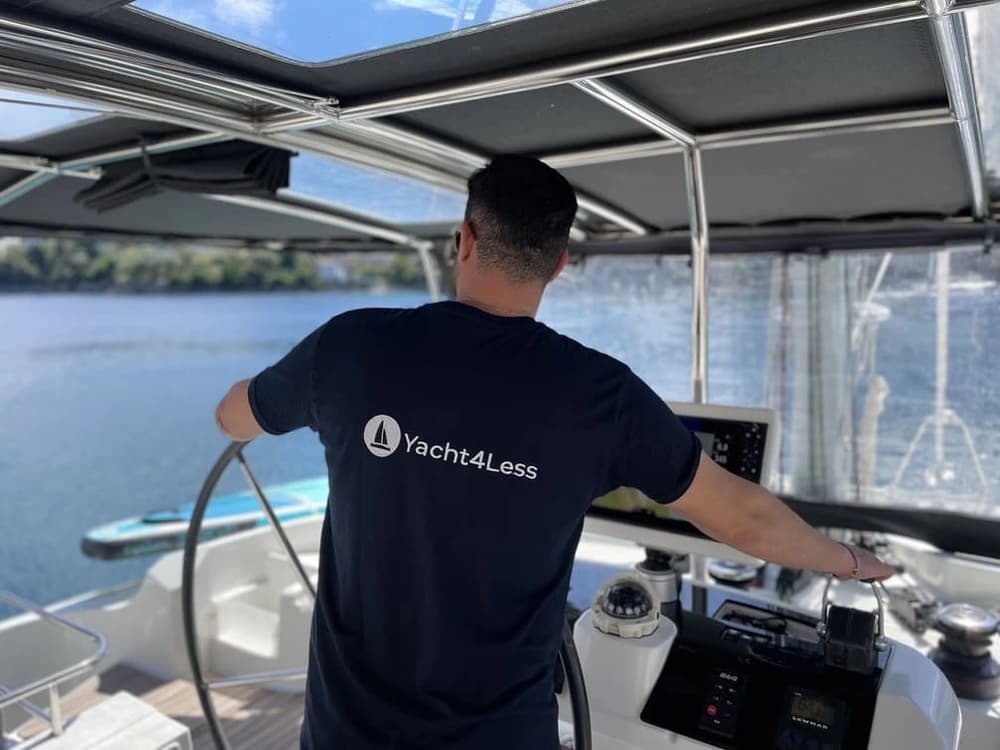
A fully crewed catamaran charter is a hosted sailing experience that includes a captain and at least one additional crew member, usually a chef or stewardess on mid-size catamarans, with larger luxury yachts carrying additional staff.
In a charter setting, the crew handles both sailing operations and hospitality. Meals are prepared and served, cabins are cleaned daily, and itineraries are curated with local knowledge. Guests are not managing logistics - they are being hosted. The experience is closer to a floating boutique hotel than a self-catered sailing trip.
The definition of what a fully crewed charter delivers is also evolving.
Industry data for 2026 points to a shift away from crowded marina stops toward more remote, exclusive destinations, the less-traveled Greek islands, the Exotics, or private anchorages in the Caribbean. Alongside this, longer and more immersive itineraries are becoming more common, with guests booking two weeks rather than one and expecting deeper cultural engagement rather than simply good food and a clean cabin.
> Browse Fully-Crewed Catamaran Charters
.webp)
The table below summarises the real-world differences that affect your charter week most directly, who is on board, who cooks and cleans, how costs are structured, how privacy works, and which travel style each option suits best.
|
|
|
|
|
|
|
|
|
|
|
|
|
|
|
|
|
|
|
|
|
|
|
|
|
|
|
|
In a skippered charter, the captain focuses exclusively on sailing and safety. In a fully crewed charter, the on-board team extends beyond navigation to include hospitality, service, and guest comfort. The presence of additional crew shifts the yacht from a bareboat charter with an added captain to a full-service, 5-star holiday environment.
On skippered yachts, the skipper is a freelance professional allocated to each charter by the charter company, selected from a pool of trusted and vetted individuals based on their availability at the time of booking. Because of this, his contact details will typically only become available approximately one week before the charter begins.
Crewed yachts, on the other hand, operate quite differently. The crew is permanently assigned to the vessel for the duration of the season, meaning guests have the advantage of reviewing detailed crew profiles and past guest feedback before committing to their booking. Furthermore, once a reservation is confirmed, guests are welcome to get in touch with the crew at any point leading up to their departure, allowing for a more personal and communicative experience from the very start.
On a skippered charter, guests actively participate in daily life on board. Planning meals, managing groceries, cleaning up, and organising day-to-day logistics become part of the experience. For many groups, particularly friends sailing together, this involvement enhances the sense of adventure and shared ownership of the trip.
On a fully crewed charter, operational responsibility is removed entirely. Meals are prepared, tables are set, cabins are refreshed, and itinerary suggestions arrive with the morning coffee. The holiday becomes slower and more indulgent, centred on relaxation rather than coordination.
A skippered charter is modular: you pay the yacht's base rate plus the skipper's daily fee, then cover food, drinks, fuel, and port fees separately. This allows flexibility and budget control but requires active expense management throughout the week.
A fully crewed charter operates on a higher weekly rate that reflects both the yacht and professional service, on an all-inclusive basis. Provisioning is typically managed through an APA - an Advanced Provisioning Allowance paid upfront and drawn down across the week - or through all-inclusive packages, which are common in Caribbean markets. The financial difference between formats is substantial, but so is the difference in what is included.
On bareboat yachts where a skipper is added, there are a few practical responsibilities the charterer should be aware of:
The exact arrangement does not need to be decided in advance; it can simply be discussed directly with the skipper once on board, allowing everyone to settle on an approach that works comfortably for all parties.
A skippered charter invites participation. Guests may assist with lines, trim sails, help with anchoring, or simply spend time at the helm while the skipper advises. The experience feels collaborative. For travellers who want to learn more about sailing without taking full responsibility for the yacht, the skippered format is genuinely well-suited.
On a fully crewed charter, sailing involvement is optional rather than expected. Guests may take the helm under supervision if they wish, but the crew manages all operations. The emphasis shifts from participation to enjoyment.
The distinction between skippered and fully crewed charters matters more than ever in 2025 and 2026, because the market itself is growing fast and diversifying. The global yacht charter market is projected to expand from approximately $9.7 billion in 2026 to over $18 billion by 2034. Catamarans now account for 30% of all booked charter weeks, driven by their reputation for comfort, stability, and space, particularly for family and group travel.
As more first-time charterers enter the market, the demand for varying service levels intensifies. The choice between a skippered and a fully crewed format has become a central part of the holiday planning conversation, not an afterthought.
> Read More: Yacht Charter Market Trends 2026
A skippered charter suits groups who want professional sailing support without giving up the hands-on, self-directed nature of the holiday. The format works particularly well in the following situations.
> Read More: Skippered Yacht Charters | The Ultimate 2026 Guide
A fully crewed charter suits guests who want the logistics removed entirely and the quality of the experience maximised. It tends to be the right choice in the following situations.
> Read More: All-inclusive Private Crewed Yacht Charters | The Ultimate 2026 Guide
.webp)
The difference between a skippered and a fully crewed catamaran charter is experiential, not technical. Both formats put you on the water on a well-maintained yacht with a professional skipper at the helm. What changes is everything around that: who cooks, who cleans, how costs are structured, and how the days actually feel.
A skippered charter offers flexibility, active involvement, and cost control. A fully crewed charter offers structure, hospitality, and elevated comfort. Neither is inherently better. The right choice depends entirely on how you want your sailing holiday to feel - independent and participatory, or curated and indulgent.
The clearest way to decide comes down to two things: the experience you are looking for and the budget you are working with. If you want full autonomy and a more hands-on sailing experience, a bareboat is your starting point, and adding a skipper for guidance or peace of mind can be arranged from as little as 10,000 EUR. If, on the other hand, you are drawn to a higher level of service and comfort where everything is taken care of from the moment you step on board, a fully crewed yacht delivers exactly that, with rates typically ranging from 25,000 EUR to 100,000 EUR and above. Knowing what kind of week you want and what you are comfortable spending will point you to the right format every time.
The yachting community's most-asked questions, answered by our experts.
Guests handle cooking and daily cleaning. The skipper's role is navigation and safety, not hospitality. Most groups find a natural rhythm within the first day, dividing meal prep, washing up, and tidying between them as they would on any shared group holiday.
It depends on the destination and operator. In the Caribbean, all-inclusive packages are common, and food, drinks, and provisioning are bundled into the weekly rate. In the Mediterranean, many fully crewed charters operate on an APA system, where guests pay an advance provisioning allowance that the crew draws from throughout the week based on actual expenses.
Yes, if you prioritise service, comfort, and convenience above all else. No, if you prefer a hands-on sailing holiday with budget flexibility and the freedom to shape your own days. Both formats offer excellent value when matched correctly to the group and the itinerary.
No. The professional skipper fulfils all legal navigation requirements. You do not need any sailing qualification to book or board a skippered charter. If you do have sailing experience, the skipper will typically invite you to participate as much as you want.
Yes. Guests on fully crewed charters may take the helm, assist with sail trim, or observe anchoring and docking - entirely by choice. The crew manages all operations, but most experienced skippers welcome guest involvement when it is wanted.
Both are growing, but skippered charters are growing fastest in proportional terms, now representing more than 21% of all charter departures. The fully crewed segment is also expanding, driven by increasing demand for luxury and immersive experiential travel, particularly in longer bookings of two weeks or more.
Absolutely. A skippered catamaran charter is ideal for family holidays, offering a perfect balance of safety and flexibility. Your professional skipper handles all navigation and mooring, allowing parents to focus entirely on their children while enjoying a bespoke itinerary tailored to the family's needs and preferred pace.








.webp)