A sailing guide that has everything you need to know about your next sailboat charters in Newport, Annapolis, Lake Champlain. An iconic yachting destination, America has a longstanding sailing tradition starting in 1851 with the first America’s Cup. Our three unique yacht charter destinations offer the best of United States sailing. Want to know more? Keep reading…
| Feature | Annapolis (Chesapeake Bay) | Newport (New England) | Lake Champlain (New York) |
| Sailing Season | May – October | May – October | May – October |
| Peak Months | July & August (80-90°F) | July & August (80-90°F) | July & August (80-90°F) |
| Typical Wind | Southerly/Westerly (5-10 knots) | Best in July (~5 knots) | Westerly (up to 8 knots) |
| Main Airport | BWI or Dulles (IAD) | PVD (closer) or Boston (BOS) | Burlington (BTV) |
| Key Attraction | Blue crabs and colonial history | Opulent mansions and yachting museums | Forested mountains and tranquility |
| Sailing Rule | No night sailing permitted | No night sailing permitted | No night sailing permitted |
The best sailing times differ drastically by region. In Florida and the Gulf Coast, winter and spring (November - April) typically offer mild temperatures and calmer seas, avoiding peak hurricane season (June - November). New England experiences prime conditions in summer (June - August), when the weather is warm and relatively stable.
The Pacific Northwest sees its best sailing from June through early September, taking advantage of drier weather and moderate winds. If you plan to sail in locations like California or Hawaii, temperate climates allow for year-round sailing, though winter can bring larger swells. Always consider local hurricane or storm seasons and plan your trip accordingly for the safest and most pleasant voyage.
What are the sailing qualification and license requirements to rent a yacht or catamaran in the USA? The United States has no federal license requirement for leisure boaters, but regulations vary by state. Many states mandate boater education or safety courses for operators above or below certain age thresholds. Charter companies may also insist on recognized credentials - such as ASA (American Sailing Association) or US Sailing certifications, or an RYA/ICC equivalent-depending on the location and size of the vessel.
Popular cruising grounds like Florida, the Chesapeake Bay, New England, and the Pacific Northwest each have distinct local rules, so it is wise to confirm specifics with your charter operator. If you lack the necessary qualifications or prefer a more relaxed trip, skippered charters or crewed yachts are readily available.
.webp)
The vast United States offers an array of regional flavors and customs. In New England, feast on lobster rolls and clam chowder, while the Chesapeake Bay area celebrates blue crabs. Southern coasts-from the Carolinas down to Florida-mix low-country boils, Cuban influences, and Creole cuisine, accompanied by lively jazz or blues music. On the West Coast, fresh Pacific seafood and wine country pairings take center stage. Major harbor cities often host seafood festivals, maritime museums, and historical waterfronts, infusing your USA sailing adventure with diverse cultural textures.
American boating laws differ across states, so local harbors may impose specific anchoring rules or mooring fees particularly in high-traffic zones like the Florida Keys or the Chesapeake Bay. If entering from international waters, clear U.S. Customs and Border Protection at an approved port of entry.
Environmental regulations also affect areas like California’s Channel Islands National Marine Sanctuary, where anchoring and fishing can be tightly controlled. Ensure your boat registration, insurance, and safety gear comply with local mandates for an uninterrupted sailing experience.
Take advantage of the amazing seafood on your charter.
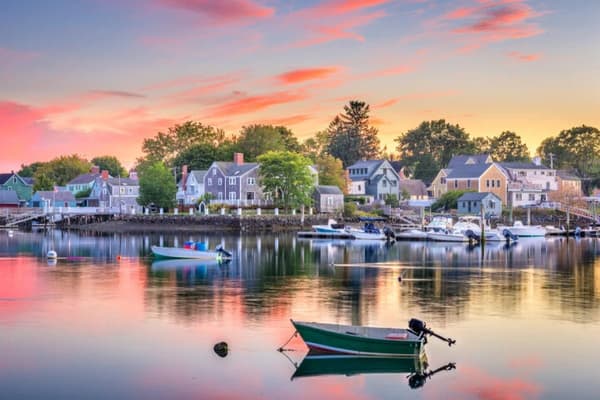
Island hop between Aquidneck Island, Block Island, Nantucket, and Martha’s Vineyard for a classic New England sailing experience. Learn all about the history of yachting at the many sailing museums, or get transported back in time to the opulent Gilded Age on a Newport Mansions tour.
Or, if you’d like something a little different head to upstate New York for an unforgettable boat rental in the USA, on Lake Champlain!
Surrounded by rural, forested mountains, you can enjoy long summer days spent hiking and swimming. Become one with nature, secluded from busy modern life. Slow down and enjoy the tiny towns and local restaurants and watering holes.
Annapolis, Newport and Lake Champlain share fairly similar climates as they are all in the Northeast Region of the United States.
This means that the best time to visit is over the summer months, between May and October.
July and August offer the warmest temperatures - ranging between 80-90°F (27-32°C), but will be the busiest. If you’re looking to escape the crowds, wait until school is back in session and catch the remaining summer weather in September and October, which often stay nice and warm. Anytime after that won’t be much fun as winters in the Northeast tend to be very cold and blustery.
Sailing conditions will differ a bit more than the weather from destination to destination. In Annapolis, you will find southerly or westerly winds of about 5-10 knots on average.
In Newport during sailing season, you will find the best wind in July, with winds reaching around 5 knots or so. Lake Champlain will have westerly winds that can reach up to 8 knots between August and December.
Sail Annapolis
As Maryland's capital, Annapolis is well-situated and very accessible. Being in such close proximity to Washington, DC also helps. To get to Annapolis, we recommend flying into BWI Airport in Baltimore, or into Dulles International Airport in Virginia. These are both very large international airports that offer direct flights from both the UK and the EU. You can also get to Annapolis from Washington, DC by train (3 hrs) or driving (3.5 hrs).
Time from BWI to Base - 40 mins by car
Time from Dulles to Base - 1 hr 20 mins by car
Sail Newport
To start your boat rental in the usa in Newport, you should fly into either T.F. Green International Airport (PVD) or Logan International Airport (BOS). T.F. is the closer option, but a smaller airport with fewer international routes. Boston is a larger regional hub and might have more options for European and UK travellers. If you choose to fly into Boston, it is easy to get to Newport via car (1.5 hrs), or bus (3.25 hrs).
Time from PVD to Base - 30 mins by car
Time from BOS to Base - 2 hrs by car/shuttle
Sail Lake Champlain, NY
For your America sailing on Lake Champlain, you’ll want to fly into Burlington International Airport (BVT). Burlington has a fairly small international airport, with limited international routes, so you may want to consider flying into a larger regional hub like Montreal, Ottawa, or New York City.
Time from BVT to Base - 10 mins by car
In all three locations, Annapolis, Newport and Lake Champlain - night sailing is not permitted.
Annapolis
If you are interested in fishing on an Annapolis yacht charter, a fishing or crabbing license is required. For provisioning, Yacht4Less recommends Giant Food, located about 1.4 miles from the base. You might also wonder about mooring on your charter, and in the Chesapeake you will rarely find mooring balls. You will likely need to book a slip at a marina or drop your anchor at an anchorage somewhere.
Newport
For mooring in Newport, there is an abundance of yacht clubs and marinas where you can “park” for the evening. For provisioning, try the Stop and Shop on Bellevue Avenue where you can find all the essentials you’ll need for your trip.
Lake Champlain, NY
It is important to note that while you do not have to account for the tides, you should be aware of any season changes in water level. Using a depth finder will help ensure you do not run aground! Finding an anchorage on Lake Champlain is a breeze. With few crowds, and a nice muddy clay bottom, you'll find good holding and secure, stress-free anchoring. Most mooring are private moorings that are not open to the public, however, if you’re looking for a more secure option than free-swinging, Burlington Harbor offers some public mooring pendants.
Day 1: Port Annapolis Marina - Herrington Harbour
Begin your Chesapeake Bay adventure from Port Annapolis Marina, one of the premier marinas on the East Coast. Cruise south to Herrington Harbour, a beautifully maintained resort marina where you can enjoy garden-lined docks, spa facilities, and waterfront dining.
Day 2: Herrington Harbour - Oxford
Set sail across the Bay to Oxford, a historic and peaceful town dating back to the 1600s. Dock along the Tred Avon River and enjoy quiet tree-lined streets, boutique galleries, and classic seafood taverns.
Day 3: Oxford - Cambridge
Sail a short distance to Cambridge, one of Maryland’s oldest colonial towns nestled on the Choptank River. Walk the revitalised waterfront district or learn about the town’s rich maritime and African American history.
Day 4: Cambridge - St. Leonard Creek
Head south into the quiet inlets of Calvert County, anchoring in picturesque St. Leonard Creek - a hidden gem for nature lovers. This peaceful anchorage is ideal for kayaking, fishing, or an evening barbecue on deck.
Day 5: St. Leonard Creek - Solomons Island
Cruise to Solomons Island, a lively sailing hub where the Patuxent River meets the Bay. Enjoy the local boardwalk, visit the Calvert Marine Museum, or unwind at a waterfront restaurant as the sun sets.
Day 6: Solomons Island - St. Michaels
Sail north across the Bay to the stylish harbour town of St. Michaels, often called the "Hamptons of the Chesapeake." Moor in the historic harbour and explore charming shops, crab shacks, and the acclaimed Chesapeake Bay Maritime Museum.
Day 7: St. Michaels - Port Annapolis Marina
Conclude your journey with a scenic return to Port Annapolis Marina. Disembark with lasting memories of classic Chesapeake sailing, timeless towns, and the gentle rhythm of the American Eastern Seaboard.
Day 1: Newport - Cuttyhunk (28 NM)
Depart from the legendary yachting capital of Newport and sail east to Cuttyhunk, the westernmost of the Elizabeth Islands. Drop anchor in the peaceful harbour and enjoy a quiet evening surrounded by unspoiled island nature.
Day 2: Cuttyhunk - Oak Bluffs, Martha’s Vineyard (28 NM)
Sail to Oak Bluffs on Martha’s Vineyard, known for its colourful gingerbread cottages and lively harbour. Spend the afternoon exploring the Victorian seafront or relaxing with a sunset cocktail on board.
Day 3: Explore Martha’s Vineyard
Take a full day to explore Martha’s Vineyard by bike or car, from the dramatic cliffs of Aquinnah to the quaint shops of Edgartown. Enjoy farm-to-table dining, vineyard tours, or sun-drenched beaches at your leisure.
Day 4: Oak Bluffs - Nantucket (30 NM)
Cruise southeast to the island of Nantucket, a former whaling hub now revered for its timeless elegance. Dock in the historic harbour and explore cobbled streets, art galleries, and upscale boutiques.
Day 5: Nantucket - Menemsha Basin (49 NM)
Sail west to the rustic and charming Menemsha Basin, a small fishing village on the western end of Martha’s Vineyard. Anchor in the calm waters and indulge in a fresh lobster roll from the dockside shacks.
Day 6: Menemsha Basin - Jamestown Island (39 NM)
Head back toward Rhode Island with a scenic sail to Jamestown Island, a tranquil and refined retreat across the bay from Newport. Enjoy views of historic lighthouses and dine ashore at one of the island’s waterfront gems.
Day 7: Jamestown Island - Newport (Check-out)
Return to Newport for check-out, completing your New England sailing circuit. Disembark with unforgettable memories of salt-tinged breezes, classic harbours, and New England charm at its finest.
Day 1: Burlington - Valcour Island, New York
Depart from the vibrant waterfront of Burlington and sail across Lake Champlain to Valcour Island, a quiet, forested gem steeped in Revolutionary War history. Drop anchor in protected Bluff Point or Sloop Cove and enjoy a peaceful first evening immersed in nature.
Day 2: Valcour Island - Willsboro Bay
Cruise south to Willsboro Bay, a long and sheltered inlet nestled between dramatic cliffs and rolling hills. This serene anchorage is ideal for swimming, paddleboarding, or relaxing with mountain views at sunset.
Day 3: Willsboro Bay - Shelburne Bay
Cross back toward Vermont and sail into Shelburne Bay, home to gentle breezes and beautiful scenery. Visit the nearby Shelburne Farms estate or explore the historic shipyard before mooring in the quiet bay.
Day 4: Shelburne Bay - Burlington
Return to Burlington for a night in this lively lakefront city. Enjoy a farm-to-table dinner, live music on the marina boardwalk, or explore Church Street Marketplace before continuing your northern journey.
Day 5: Burlington - Mallets Bay
Head north to Mallets Bay, one of the most scenic and popular sailing destinations on Lake Champlain. Drop anchor in the sheltered basin and spend the day exploring hidden coves and forested shorelines.
Day 6: Mallets Bay - Burton Island
Sail to Burton Island, a car-free state park offering peaceful trails, picnic areas, and excellent swimming spots. Moor in the protected marina or anchor offshore for a night under the stars.
Day 7: Burton Island - Roche State Park, New York - Burlington
On your final day, stop at New York’s Roche State Park, a quiet and undeveloped stretch of shoreline ideal for a midday break. Then sail back across the lake to Burlington and disembark, completing your relaxed, nature-filled voyage on Lake Champlain.
Meanwhile, if you’re eyeing more challenging or unfamiliar U.S. waters, skippered charters provide peace of mind; let a seasoned captain take you through New England’s historic harbors or navigate the pristine San Juan Islands of the Pacific Northwest while you relax and enjoy the ride.
For the pinnacle of ease and comfort, fully crewed yacht charters in the USA can deliver a luxury experience - picture a crewed sailing yacht journey among Maine’s rugged islands or a private yacht cruise at sunset along Miami’s skyline, complete with a team tending to your every need onboard.
It depends. For example, the most important ones are the type of boat you will choose and whether you require a professional crew on board (e.g. skipper, hostess or cook). So, as you can see, there are many factors that can shape a price for a boat rental.
Check our full guide about yacht charter cost and how you can save much money in your next sailing holidays.
The yachting community's most-asked questions, answered by our experts.
The United States offers iconic sailing grounds from New England and Chesapeake Bay to Florida, California, and the Pacific Northwest. Each region combines rich maritime history with diverse landscapes and cultural experiences.
It varies by region: Florida and the Gulf Coast are best from November–April, New England shines June–August, and the Pacific Northwest is best June–September. California and Hawaii offer year-round sailing.
There is no federal license requirement, but state laws differ. Many states require boating safety courses. Charter companies may also ask for ASA, US Sailing, RYA, or ICC certification. Skippered charters are available for all levels.
New England offers lobster rolls and chowder, the Chesapeake Bay is famous for blue crabs, the South blends Creole and Cuban flavors, and the West Coast showcases Pacific seafood and wine pairings.
Yes. Rules vary by state and harbor. Some regions charge mooring fees or restrict anchoring near reefs and marine sanctuaries. International sailors must clear U.S. Customs at approved ports.
Conditions vary: expect 5–15 knot breezes in Chesapeake Bay, light summer winds in Newport, stronger trade winds in Hawaii, and tidal shifts up to several meters in some areas.
Depending on location, you may see dolphins, whales, manatees, sea turtles, bald eagles, and diverse fish species. New England waters are prime whale-watching grounds.
Bareboat charters start around €2,500/week, while luxury catamarans or fully crewed yachts can exceed €15,000/week depending on region, yacht size, and season.
Top bases include Annapolis on Chesapeake Bay, Newport in New England, and Lake Champlain in New York. Florida, California, and Hawaii are also popular sailing regions.
While the Bahamas are geographically close to Florida, crossing the Gulf Stream requires careful weather planning and offshore experience. A standard charter agreement may have restrictions on "blue water" crossings. If you intend to sail between the USA and the Bahamas, you must clear customs in both countries and ensure your insurance specifically covers international transit.