Welcome to the 2026 Sailing Terminology Guide by Yacht4Less. The clear, friendly Guide for every sailor. Sailing has its unique language that every beginner benefits from mastering to enjoy a safe and confident experience on the water.
Key terms include basic boat parts such as the bow (front), stern (back), port (left), and starboard (right), which help with clear communication on board. Understanding core maneuvers like tacking (turning the bow through the wind) and jibing (turning the stern through the wind) builds foundational sailing skills.

Knowing the points of sail, such as close-hauled and beam reach, helps new sailors adjust their course relative to the wind’s direction. Familiarity with safety essentials, including life jackets, man overboard procedures, and VHF radio calls, is crucial for smooth and secure sailing.
Basic rigging terms like halyards and sheets describe the ropes used to raise and trim sails. This terminology empowers beginners to actively participate in sailing or confidently charter a yacht, setting the stage for memorable, stress-free trips.
Along the way, you’ll also find timely market insights: demand for charters is growing, multihulls are trending, and travelers are choosing experiences that blend comfort, privacy, and sustainability - great signals for anyone considering a sailing holiday.
Knowing the anatomy of a sailboat makes everything easier - especially when a skipper calls out instructions while you’re underway.
Hull: The boat’s body that floats and carries everything.
Bow / Stern: Front/back. “Forward” means toward the bow; “aft” means toward the stern.
Port / Starboard: Left / right when facing the bow. (Memory tip: port and left both have four letters.)
Deck: The surface you move across; it can include foredeck, side decks, and cockpit area.
Cockpit: The working hub where you steer, trim, and manage lines.
Helm: The steering station (wheel or tiller).
Rudder: The underwater fin that turns the boat.
Keel: The weighted fin that keeps the boat upright and reduces sideways drift.
Mast / Boom: Vertical and horizontal spars supporting and shaping the mainsail.
Cabin / Saloon: Interior living area.
Galley: The kitchen.
Head: The bathroom.
Cleat: A fitting for securing lines with a cleat hitch.
Anchor: The seabed-gripping device that holds you in place.
Why it matters for charters: Clear terminology saves time and prevents confusion in tight spots - like mooring, docking, or setting the anchor in a busy cove.

These are the core maneuvers you’ll practice or observe on any cruise:
Tack (Coming About): Turning the bow through the wind to change sides when heading upwind.
Jibe (Gybe): Turning the stern through the wind to change sides when heading downwind; control the boom to avoid a hard swing.
Head Up / Bear Away: Steer toward the wind (head up) or away from it (bear away / fall off).
Luff: A sail flaps when pointed too close to the wind or eased too far.
Heave-To: A controlled pause using opposing sail and rudder; useful for a break, a quick fix, or heavy weather.
Moor / Dock / Anchor: Tie to a mooring buoy, berth at a marina, or set the anchor so it digs in.
Pro tip: Practice maneuvers in light air first. Smooth crew communication - short calls and repeat-backs - turns hectic moments into a calm routine.
Sailboats don’t go straight into the wind. Instead, they sail at angles to it, called the points of sail:
In Irons (No-Go Zone): Pointing at the wind, sails luff, the boat stalls.
Close-Hauled: As close to the wind as practical; sails trimmed tight.
Close Reach / Beam Reach / Broad Reach: Wind moves progressively aft along the side: slightly forward (close reach), right on the beam (beam reach- often fast and comfy), and from behind at an angle (broad reach).
Run (Downwind): Wind from dead astern; watch for accidental jibes.
Other essentials:
Windward / Leeward: Toward / away from the wind.
Port Tack / Starboard Tack: Which side the wind hits first (important for right-of-way).
Abeam / Ahead / Astern: Side of the boat; in front of; behind.
True Wind / Apparent Wind: Actual wind vs. what you feel while moving (you trim to apparent wind).
Why catamarans shine here: On reaches and downwind legs, multihulls are famously stable and spacious, making them a favorite for groups and families—one reason catamaran charter demand has climbed in recent seasons, and catamarans often show higher peak-season occupancy vs. monohulls.
Navigation basics
Nautical Mile (NM): ~1.852 km (1.15 land miles).
Knot: 1 NM per hour.
Bearing / Heading: Direction to a target vs. the direction the bow points.
Chart / Chartplotter: Nautical maps (paper or electronic) showing depths, hazards, and aids to navigation.
Draft: How deep the boat sits (keel depth). Know it before entering the shallows.
Right-of-way (very simplified)
Starboard-tack boat typically stands on over a port-tack boat.
Leeward has priority over windward on the same tack.
Sailing vessels generally have priority over power (with exceptions).
Everyone shares the duty to avoid collision - when unsure, slow down and communicate.
Safety essentials
Lifejacket/PFD: Wear when conditions warrant or when briefed to do so.
Lifelines/Jacklines: Safety lines to reduce fall risk or clip in a harness.
MOB (Crew Overboard): Shout, keep visual, throw flotation, maneuver for pickup, mark GPS if available.
VHF Channel 16: Distress/hailing. Mayday (grave danger), Pan-Pan (urgent), Sécurité (navigational/weather safety).
EPIRB/PLB: Satellite distress beacons.
Flares: Visual distress signals.
Bilge/Bilge Pump: The Lowest area of the hull and the pump that removes water.
Good habit: Ask for a boat and area briefing at the start of every charter—gear locations, radio steps, local hazards, and a reefing plan.
Sails
Mainsail: Primary sail attached to mast and boom.
Jib / Genoa (Headsail): Forward sail on the forestay; genoas overlap and add power.
Lines you’ll actually touch
Halyards: Hoist/lower sails.
Sheets: Trim sails (angle to wind).
Traveler: Adjusts boom position side-to-side.
Vang (Kicker): Pulls boom down to control leech tension/twist.
Outhaul / Cunningham: Fine-tune sail shape (flatter for strong wind, fuller for light).
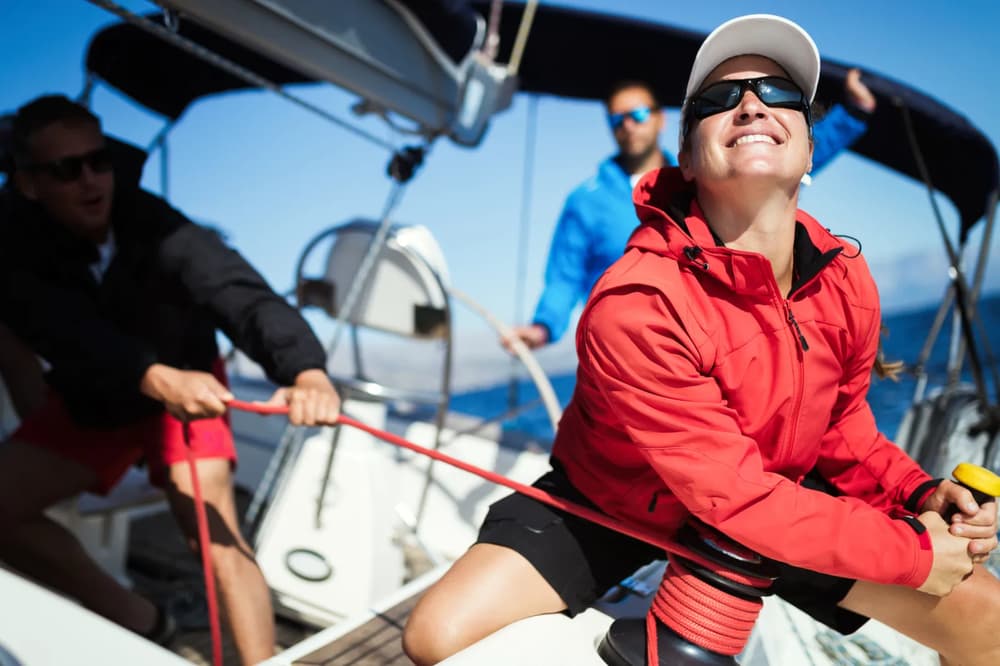
Winch: Drum providing mechanical advantage for trimming.
Core actions
Trim / Ease: Pull in or let out to balance power and heel.
Reefing: Reduce sail area as wind builds (reef early for comfort and control).
Furling: Roll sails for stowage or partial area (very charter-friendly).
Rigs (quick decode)
Sloop: One mast, main + one headsail (most common).
Cutter: One mast, two headsails.
Ketch / Schooner: Two masts (different layouts).
Catamaran rigs: Typically sloop-rigged, optimized for easy handling and comfort.
Bareboat Charter: Boat without crew; you or your party skipper and manage the vessel.
Skippered Charter: Boat with a professional captain; help as much or as little as you want.
Crewed Charter: Captain plus full crew (chef/host/deckhand), often with all-inclusive service.
Flotilla: Independent sailing in a guided group with a lead boat for routing/support.
Cabins & Berths: Sleeping spaces (e.g., “4 cabins + 2 salon berths”).
Heads & Showers: Number of bathrooms (often ensuite in larger yachts/cats).
Galley & Provisioning: Kitchen + the food/drinks stocked pre-departure (self-provisioned or arranged).
APA (Advanced Provisioning Allowance): Prepaid expense fund typical on luxury crewed charters.
One-Way Charter: Start in one port, finish in another (subject to availability/fees).
Dockage/Mooring Fees: Marina slips or national park moorings during your trip.
Boat/Area Briefing: Handover of systems, safety, local routes, and hazards.
Sailing Itinerary: A flexible route plan tailored to weather and preferences.
Conversion tip: For first-time charterers, a skippered catamaran charter offers comfort, privacy, and space - ideal for families and mixed-ability groups.

If there’s one variable that shapes every sailing day, it’s the wind. Before you set off on a yacht or catamaran charter, get comfortable with two things:
the points of sail (the angle your boat makes to the wind), and
The local named winds - they tell you a lot about direction, seasonality, sea state, and comfort onboard.
Meltemi / Etesian (Aegean, Greece & Türkiye): Predominantly N–NE summer winds, strongest June–September (peaks in July–August). Can bring fresh to strong conditions and short, steep seas between islands - plan shorter hops and earlier starts.
Maestral / Maistros (Adriatic & Ionian): A fair-weather, thermal NW breeze that builds by early afternoon in late spring to early autumn - fantastic for lively but manageable afternoon sailing; calmer mornings for swims and transfers.
Bora / Bura (Adriatic, esp. Croatia & Slovenia): A cold, NE katabatic wind, gusty and squally, most common autumn–spring (can occur anytime). Expect sudden blasts and clear skies after passage; seek shelter early if it’s forecast.
Jugo / Sirocco (Central & Eastern Med): Warm, humid SE–S wind originating over North Africa; brings haze, swell, and sometimes rain. More frequent autumn–spring; in the Adriatic it’s called Jugo (long fetch = bigger seas).
Mistral (Gulf of Lion, S. France): Strong, dry NW–N wind funneled by the Rhône valley, year-round but notable winter–spring. Can produce very rough seas toward Corsica/Sardinia - check local forecasts carefully.
Tramontana / Tramuntana (W. Med: N. Corsica, Balearics, Catalonia): A N–NW wind, often cooler and drier; can be brisk. In the Balearics, a Tramuntana spell means clear air and choppy north-facing anchorages.
Libeccio / Garbí / Πουνέντης (Western & Central Med): A SW wind that brings lumpier seas on west-facing coasts; can be reinforced by low-pressure systems.
Grecale / Gregale (Ionian–Central Med, incl. Malta): A NE wind that can blow hard over long fetches, building swell toward the central Med islands.
Ostro / Scirocco-South (Italy, Adriatic): Generic S wind name in Italian waters; expect warmer air, humidity, and a building sea.
Levante / Levanter (Strait of Gibraltar & W. Med): Persistent E wind funneled through the Strait; can create cloud caps over the Rock and strong currents/overfalls - timing the tide matters.
Poniente / Ponent (W. Med, Spain): The counterpart to Levante: W wind bringing drier, clearer conditions to Andalusia and the Balearics.
Marin (Gulf of Lion coast, France): Moist SE onshore wind; builds swell and low cloud along Languedoc-Roussillon/Provence coasts.
Sirocco (pan-Med term; “Jugo” in the Adriatic): Worth repeating as a pan-Med label for SE Saharan-sourced flows; dust, haze, and southerly swells are typical signals.
Charter tip: In summer, plan earlier departures to enjoy smoother seas before afternoon thermals (e.g., Maestral) fill in. In shoulder seasons, watch for systems that trigger Mistral, Bora, Tramontana, or Gregale - shorten legs, add bail-out anchorages, and book marinas with good lee.
Useful local winds outside (or adjacent to) the Med
Alisios / Alizé (Atlantic & Caribbean trades) – The reliable NE trades in the Northern Hemisphere (and SE in the Southern). In the Caribbean, expect E–NE trades that freshen in winter; great for steady reaching on island hops.
Helm Wind (Cumbria, UK): A localized, gusty NE downslope wind on the Pennines (Cross Fell). Rare for charters, but a good example of katabatic behavior.
Harmattan (W. Africa): A NE dry wind in winter that can carry dust across the Atlantic; occasionally influences visibility in the far E. Atlantic.
Khamsin / Chamsin (Egypt & E. Med fringe): A hot, dry S–SE wind in spring that can raise temperatures and reduce visibility with dust.
Papagayo / Tehuano (Central America gap winds): Strong NE and N gap winds that spill into the Pacific from the Caribbean/Tehuantepec - relevant for ocean delivery passages and bluewater planners.
Nor’easter (U.S. East Coast): A NE gale pattern that can bring heavy weather and swell - key for Atlantic itineraries or repositioning voyages.
Williwaw (High-latitude fjords): Violent katabatic gusts off steep terrain (Alaska/Patagonia); advanced cruising only.
Keep your original quiz, now enriched with extra questions for engagement. Place the answers at the very end of your page.
Original questions (kept):
What do you call the toilet on the boat?
A) Hold B) Helm C) Head
What is another term for the back of the boat?
A) Port B) Aft C) Starboard
Where do you anchor the boat?
A) Mooring B) Jibe C) Port
What is another way to express one nautical mile per hour?
A) Keel B) Boom C) Knot
Enriched questions (new):
Which side is the port when you face the bow?
A) Left B) Right C) Depends on the tack
Which maneuver turns the bow through the wind?
A) Jibe B) Tack C) Heave-to
Which point of sail is typically fast and comfortable, with wind directly over the side?
A) Beam reach B) Close-hauled C) Run
What does reefing do?
A) Increases sail area in light wind
B) Reduces sail area in strong winds
C) Changes the boat’s draft
Windward means:
A) Away from the wind B) Toward the wind C) Downwind of the boom
Which line is used to hoist a sail?
A) Sheet B) Halyard C) Vang
What does in irons mean?
A) Boat is heeled hard on a reach
B) Boat is pointing into the wind and stalled
C) Boat is anchored
On a skippered charter, who is primarily responsible for navigation and boat handling?
A) The guests
B) The skipper (captain)
C) The marina staff
Which hull type commonly offers more deck space and stability for families?
A) Monohull B) Catamaran C) Trimaran only
Which call on VHF Channel 16 signals grave and imminent danger?
A) Pan-Pan B) Sécurité C) Mayday
What’s the quickest way to depower sails momentarily?
A) Luff up B) Add more halyard tension C) Bear away hard
Answers (for you to place after the quiz)
C 2) B 3) A 4) C 5) A 6) B 7) A 8) B 9) B 10) B 11) B 12) B 13) B 14) C 15) A
Booking your first yacht charter is easy with Yacht4less, but it certainly helps to have a little sailing terminology under your belt. Now that you’re up to speed with some of the basics, it’s time for the fun part—picking your dream sailing holiday destination and choosing which type of yacht you’d like to charter.
To get started, head to our Sailing Hub for detailed sailing destination guides, inspiring itineraries, yacht model reviews, sailing tips, and more.
For real-time availability and pricing on sailing yacht, catamaran, gulet, power catamaran, and motorboat deals, visit our real-time search engine. This tool allows you to explore the best charter options instantly and secure your dream yacht charter with ease. Otherwise, feel free to send us your yacht charter enquiry, and a yacht charter expert from Yacht4Less will provide you with a tailor-made, non-binding quote.
The yachting community's most-asked questions, answered by our experts.
Knowing nautical terms improves safety, communication with crew, and overall confidence when chartering or skippering a yacht.
Key terms include bow (front), stern (back), mast (sail support), boom (horizontal spar), keel (stabilizer), and helm (steering control).
Facing the bow (front), port is the left side of the boat, while starboard is the right.
A bareboat charter is when you rent the yacht without a crew, meaning you or your skipper are fully responsible for navigation and safety.
A berth refers to a sleeping space or cabin on a yacht.
Reefing is the process of reducing sail area to make the yacht easier to handle in stronger winds.
These describe the boat’s angle to the wind, including close-hauled, beam reach, broad reach, and downwind sailing.
Both are maneuvers to change direction. A tack turns the bow through the wind, while a jibe turns the stern through the wind.
Windward is the direction the wind is coming from, while leeward is the opposite direction, sheltered from the wind.
Study guides like this, take online sailing courses, or join a short day-sail with a skipper to get familiar with terms in real practice.
Both reduce the amount of sail area exposed to the wind, but they work differently. Furling rolls the sail away entirely or partially using a drum system, typically used for headsails like a genoa or jib. It is fast, simple, and ideal for quick adjustments in changing conditions. Reefing reduces the mainsail by lowering it partway and securing the excess cloth to the boom. It retains the sail in use but in a smaller, more controllable form. Most modern charter yachts have roller-furling headsails and slab-reefing mainsails, giving sailors straightforward options for managing sail area as the wind builds.